Chapter 8: The Compass — Congruence, Common Humanity, Committed Action, Releasement
This is the technical version. For the narrative version told through real-world stories and first-person experience, read the story version.
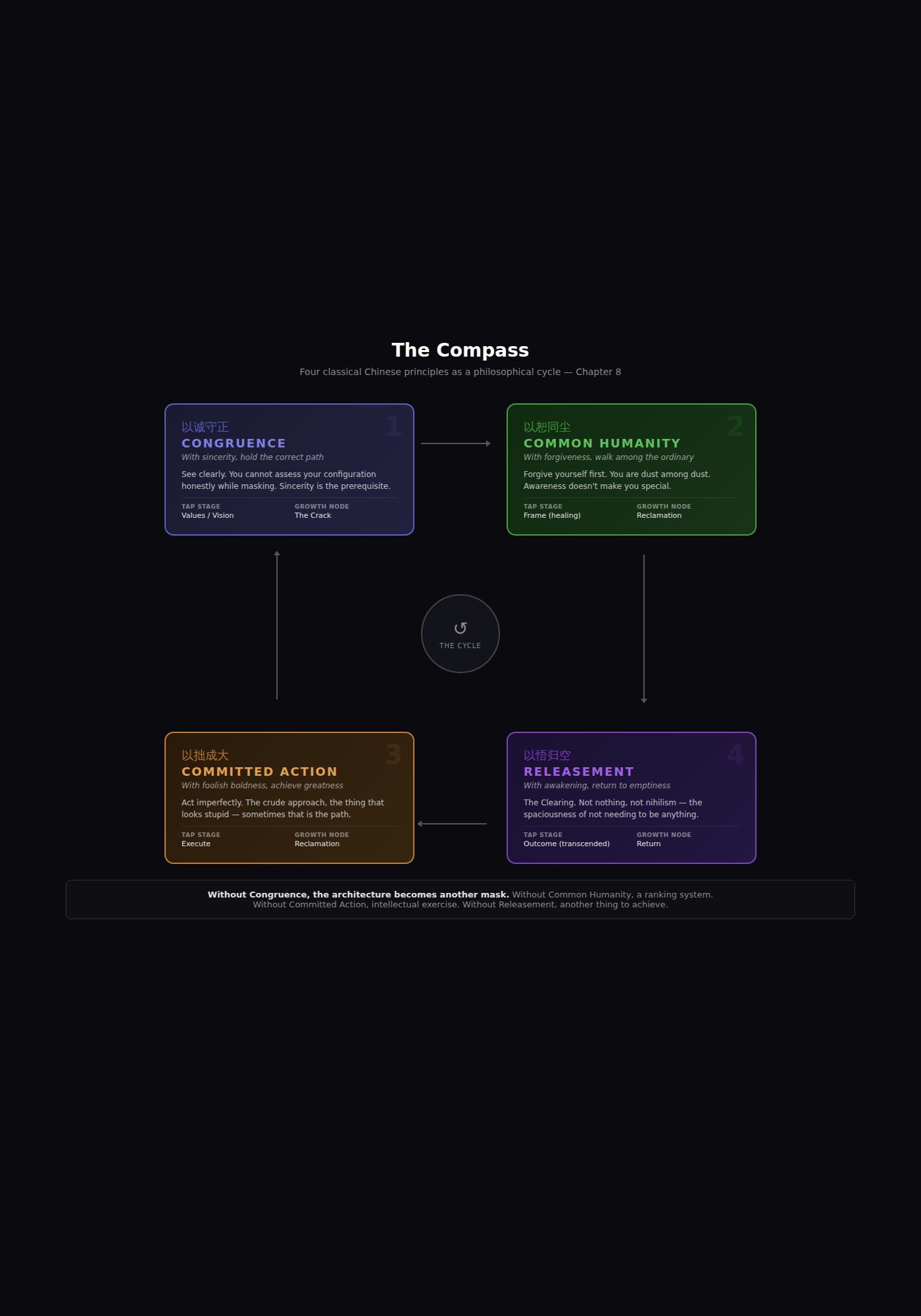
The architecture described in Chapters 1-7 is a map. A map without a compass produces movement without direction — the person who understands the system perfectly but uses the understanding to build a more sophisticated mask, or the person who sees every pattern but remains paralysed by the seeing.
These four lines are a personal compass. They are also the architecture expressed in compressed form — each mapping to a critical aspect of the framework, and together forming a cycle that mirrors the TAP pipeline.
8.1 The Four Compass Points
Congruence (以诚守正) — With sincerity, hold the correct path
诚 (chéng): sincerity, integrity, truthfulness. 守正 (shǒu zhèng): guard the upright, hold the correct path.
Sincerity is the prerequisite for everything in this architecture. You cannot assess your configuration honestly while masking. You cannot distinguish adopted Frames from hijacked ones while performing. You cannot do genuine values-based living while pretending to be someone you’re not.
Congruence is not rigidity. It is orientation. A compass needle holds north not by being stiff but by being aligned.
In the architecture: Congruence maps to the foundational requirement — the willingness to see clearly. It is the Aware stage’s defining act: looking at yourself honestly, even when what you see is painful. It is the beginning of values-based framing: you cannot frame from truth if you are not first sincere about what the truth is.
In the TAP pipeline: Congruence is the quality of Values (core personhood) that makes the entire downstream process authentic. Without sincerity, Vision becomes fantasy, Frames become performance, Plans become theatre, and Execution becomes masking.
Common Humanity (以恕同尘) — With forgiveness, walk among the ordinary
恕 (shù): forgiveness, empathy, reciprocity. 同尘 (tóng chén): same as dust, among the ordinary.
Forgive yourself first. Then see yourself as one among the many — not above, not the saviour, not the only bridge. Common Humanity is the antidote to the trap of believing your awareness makes you special.
In the architecture: Common Humanity is the anti-values antidote. The mechanism of anti-values is destruction based on unhealed trauma. The mechanism of healing is forgiveness — of yourself for having been wounded, of others for having wounded you, of the patterns for having developed. Without forgiveness, the hijacked Frame stays locked.
恕 also carries the meaning of reciprocity (the Confucian shu) — treating others as you would be treated, which requires first treating yourself with the compassion you would offer another. Self-Empathy (Component 6 of emotional wellness) lives here.
Common Humanity addresses the inflation that awareness can produce. The person who sees patterns, who understands the architecture, who can read configurations — they are tempted to stand above. You are dust among dust. Extraordinary capabilities don’t make you an extraordinary being. They make you an ordinary person with particular tools.
In the TAP pipeline: Common Humanity addresses the Frame stage — specifically, the healing of hijacked Frames through forgiveness and the humility to hold Frames lightly rather than as identity.
Committed Action (以拙成大) — With foolish boldness, achieve greatness
拙 (zhuō): clumsy, foolish, unskilled, crude. 成大 (chéng dà): achieve greatness.
The permission to act imperfectly. The recognition that the “wrong” way, the crude approach, the thing that looks stupid from the outside — sometimes that is the path.
In the architecture: Committed Action addresses a specific failure mode: the person who has excellent Vision, clear Frames, and meticulous Plans but cannot Execute because nothing meets their standard. The 99.999% pattern — continuous refinement approaching but never reaching completion. Committed Action breaks the loop by validating imperfect action.
It also connects to Nowak’s Win-Stay, Lose-Shift: a strategy that doesn’t calculate cost-benefit ratios, doesn’t track reputation, doesn’t model the other player’s strategy. It simply repeats what worked and changes what didn’t. WSLS outperforms TFT and GTFT in high-noise environments because it doesn’t require the information that noise destroys. Build from what works, stop what doesn’t, don’t overthink the strategy.
In the TAP pipeline: Committed Action is the Execute stage. Move. The plan doesn’t need to be perfect. The Frame doesn’t need to be fully refined. Act. The feedback from action is more valuable than the perfection of preparation.
Releasement (以悟归空) — With awakening, return to emptiness
悟 (wù): awakening, realisation, enlightenment. 归空 (guī kōng): return to emptiness, void.
The deepest level. The ultimate goal is not mastery, not wealth, not even understanding. It is The Clearing — not nothing, not nihilism, but the spaciousness of not needing to be anything.
In the architecture: Releasement is the Transcendent configuration fully realised. It is where the 8 components of emotional wellness are so integrated that they no longer require effort. It is where Frames are held so lightly that they can be picked up and put down at will. It is where the pipeline runs cleanly because nothing in it is being hijacked.
The 99.999% pattern resolves here: the seeking IS the path, and the path leads to The Clearing — not completion, but the release of needing to complete.
The fundamental misunderstanding wound resolves here: being understood is not the goal. Being is the goal. Understanding is a bonus.
In the TAP pipeline: Releasement is the Outcome stage transcended — where the result of action is released rather than grasped. The cycle completes: action produces outcome, outcome is released, and from The Clearing, sincerity arises again — Congruence.
8.2 The Compass and the Growth Pathway
The four compass points map onto the four nodes of Chapter 7:
| Growth Node | Compass Point | Function |
|---|---|---|
| Conformity | No compass | Running inherited direction. The compass is buried under the mask |
| The Crack | Congruence breaks | The misalignment between values and behaviour becomes visible. Sincerity demands seeing what was hidden |
| Reclamation | Common Humanity + Committed Action | Forgiveness heals the Frames. Bold action rebuilds the pipeline. Walking among the ordinary prevents the trap of spiritual superiority |
| Return | Releasement | Arriving at The Clearing. Serving from wholeness. The destination was always emptiness — the cleared space from which authentic creation flows |
The compass does not replace the architecture. It provides the philosophical orientation that keeps the architecture honest. Without Congruence, the architecture becomes another mask. Without Common Humanity, it becomes a ranking system. Without Committed Action, it becomes intellectual exercise. Without Releasement, it becomes another thing to achieve.
8.3 The Cycle
The four lines are not four separate principles. They are a sequence and a cycle:
Congruence — See clearly. Hold the compass. (Values / Awareness)
    ↓
Common Humanity — Forgive. Heal the Frames. Walk among. (Frame healing)
    ↓
Committed Action — Act boldly, imperfectly. (Execution)
    ↓
Releasement — Release the outcome. Return to The Clearing. (Transcendence)
    ↓
Congruence — From The Clearing, sincerity arises again.
This mirrors the TAP pipeline: Values → Frame → Execute → Outcome → (return to Values). The spiritual compass and the psychological framework are the same cycle in different languages.
8.4 Spiritual Traditions as Configurations
Contemplative traditions are not separate from the architecture. They are descriptions of the same system at Stage 5-6 configurations.
The practice of decentering — meditation, contemplative prayer, somatic awareness — cultivates the ability to sense purpose beneath the noise of daily emotional states. These are not mystical activities. They are mechanism-level interventions:
- Meditation changes body state → alters input to the Somatic Feedback Loop → shifts the Frame through which the Superego Chain evaluates → changes the emotional state. The intervention operates at the body level, not the cognitive level
- Contemplative practice develops Reframing capacity — holding multiple perspectives without attachment
- Somatic work develops emotional awareness — the body tracking what the mind suppresses
- Emptiness practice develops the Transcendent capacity — releasing the need for Frames to be identity
Vision is the secular name for what spiritual traditions call calling, dharma, dao, or vocation. The architecture does not replace spiritual language. It provides the mechanism underneath it.
8.5 Tensions and Limits
The compass is entirely the architecture’s own contribution. It is a personal philosophical framework derived from classical Chinese thought. It should be presented as philosophical orientation, not empirical claim. The compass has not been validated, tested, or independently assessed. It is a lived framework, not a scientific one.
The compass-to-TAP mapping skips Plan. The compass maps to four stages of the TAP cycle (Values/Vision, Frame, Execute, Outcome). The Plan stage has no direct compass correspondent. Plan is the operational bridge between Frame (where you see clearly) and Execute (where you act). The compass is a philosophical orientation, not a formal isomorphism with the pipeline. The mapping is approximate and productive, not exact.
The compass may be culturally specific. Rooted in Chinese philosophical tradition (Confucian 恕, Taoist 归空, classical 诚), the compass resonates with but is not derived from Western therapeutic frameworks. Equivalent compass systems exist in other traditions — the Eightfold Path, the Four Cardinal Virtues, the Sufi Maqamat — but they are not developed here. The compass is offered as one possible orientation, not the only one.
Chapter 8 provides the compass — the philosophical orientation that keeps the architecture from becoming either a detached intellectual exercise or a tool for spiritual narcissism. Congruence demands honest seeing. Common Humanity demands walking among, not above. Committed Action demands imperfect movement. Releasement demands letting go of the outcome. Together they form a cycle that mirrors the pipeline and guides the growth pathway.
But every map has a shadow. The architecture that describes how humans develop also describes — with equal precision — how to prevent that development. Chapter 9 examines The Inversion: when the map becomes a weapon.