Chapter 4: The Conditions — What the System Needs to Run Well
This is the story version. For the formal academic version with full theoretical apparatus, read the technical version.
The first environment I remember clearly was safe, warm, and small. My mother’s orbit. Close, protected, sheltered — probably too sheltered, though I wouldn’t understand that until much later. It was a hull built for a harbour, not for open water. And when I was launched into the ocean of primary school, I discovered that the hull had been built without the parts I’d need for the conditions I was entering.
The second environment — the playground, the classroom, the group chat I wasn’t added to — was where I learned that the system doesn’t just run inside you. It runs inside the conditions around you. The same kid who was fine at home was drowning at school. Same hardware, same wiring, same person. Different conditions, completely different output.
That pattern repeated for the next twenty-five years. I was one person in music communities where I could be myself, and a different person in professional environments where the mask was required. One configuration in relationships where I felt safe, another configuration entirely when the relational field triggered old wounds. It wasn’t until I started mapping the conditions — the specific structural, relational, and environmental factors that either supported or broke my development — that I understood: Chapters 1-3 describe the individual, but the individual doesn’t exist in isolation. The mechanism needs input from an environment. The direction of Frames is shaped by relational experience. The pipeline runs within conditions that either support or obstruct its clean operation.
This chapter maps those conditions. The central finding: individual development and structural conditions are both necessary and neither is sufficient alone.
4.1 The Needs System: Hull and Sail
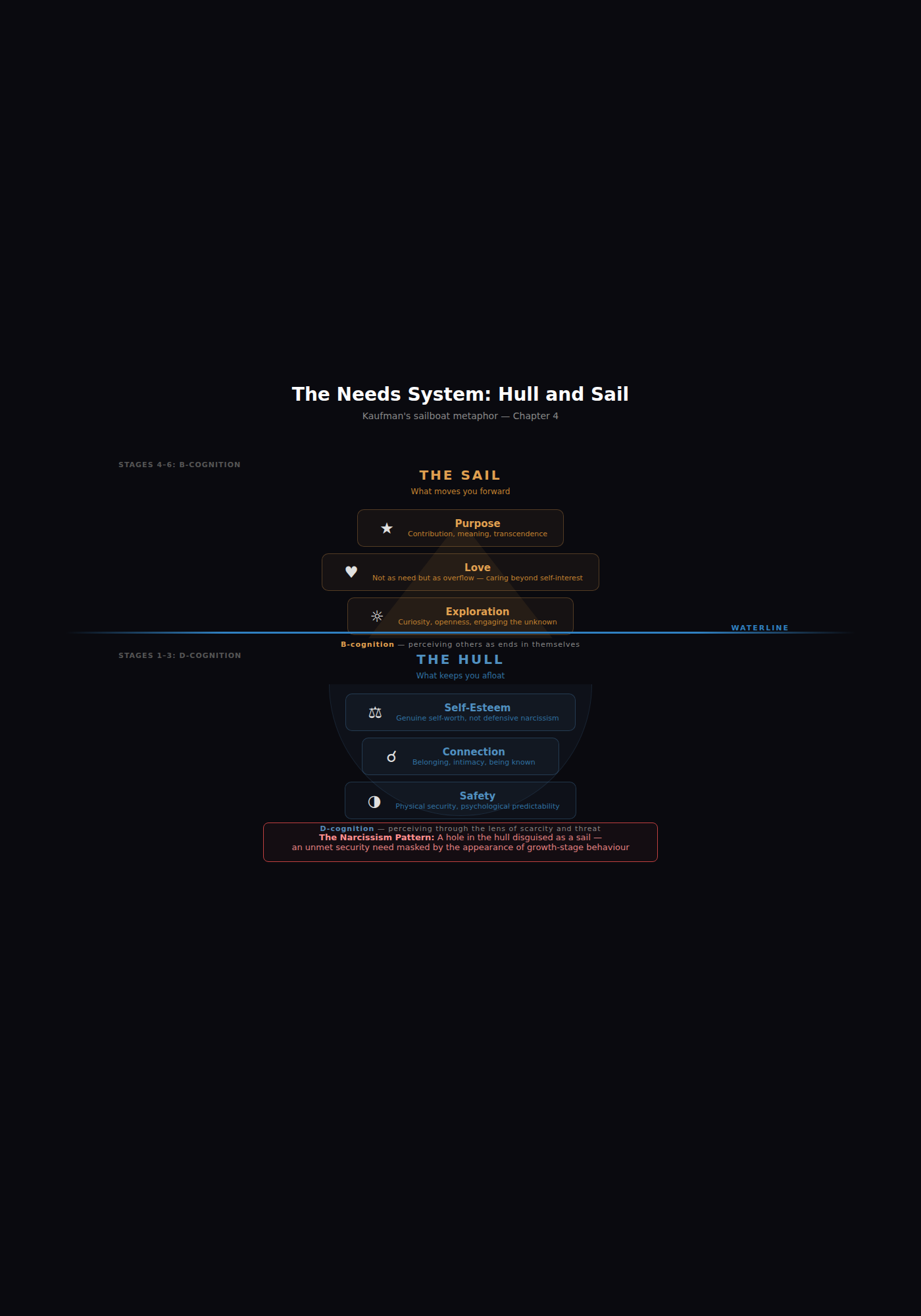
My mother built the Safety part of the hull beautifully. I was never in physical danger. I was never hungry, never cold, never uncertain about whether I would be cared for. But the Connection part — belonging, being known by peers — was missing entirely. Not because my mother failed. Because the environment I was launched into required social skills I hadn’t been exposed to, and by the time I noticed the gap, the gap had become a target on my back.
Scott Barry Kaufman (Transcend, 2020) gave me the language for this. He reframes Maslow’s hierarchy not as a rigid ladder but as a sailboat:
The Hull — what keeps you afloat:
- Safety — physical security, psychological predictability
- Connection — belonging, intimacy, being known
- Self-Esteem — genuine self-worth (not defensive narcissism — see Chapter 2, Section 2.6)
The Sail — what moves you forward:
- Exploration — curiosity, openness, willingness to engage the unknown
- Love — not as need but as overflow, caring beyond self-interest
- Purpose — contribution, meaning, transcendence
The hull must be seaworthy before the sail can catch wind. A person bailing water cannot simultaneously navigate toward purpose. But this is not a rigid sequence — hull repair and sail deployment interact dynamically. A moment of purpose can motivate hull repair. A burst of exploration can reveal that the hull is more seaworthy than feared.
Music was my first sail before the hull was ready. I found bands, online communities, spaces where curiosity and intensity were valued instead of punished. The hull was still leaking — I was still bullied, still disconnected at school, still performing a version of normal that didn’t fit — but the sail gave me a reason to keep bailing. Purpose before safety. Not the textbook order. But it worked.
I spent most of my twenties not knowing which one I was running. Kaufman draws a critical distinction: D-cognition vs B-cognition. Deficiency-cognition perceives the world through the lens of scarcity and threat — others are tools, competitors, or dangers. Being-cognition perceives others as ends in themselves, the world as interesting rather than threatening. D-cognition maps to Stages 1-3 (the system managing unmet needs). B-cognition maps to Stages 4-6 (the system operating from sufficiency).
I saw people as potential connections to earn, potential threats to manage, potential audiences to perform for. Not because I was cynical — because the hull was taking on water and D-cognition was the natural response. The saviour mode (Chapter 3) was D-cognition wearing B-cognition clothing: it looked like love, like care, like generosity. But underneath, it was managing the threat of disconnection. Real B-cognition — seeing people as people, not as sources of belonging I needed to secure — didn’t arrive until the hull was finally patched.
The narcissism pattern (Chapter 2) in hull terms: narcissism is a hole in the hull disguised as a sail — an unmet security need masked by the appearance of growth-stage behaviour. Remove the audience, and the hull shows its holes.
Manfred Max-Neef’s nine fundamental human needs provide the specific content of what the hull requires: subsistence, protection, affection, understanding, participation, leisure, creation, identity, freedom. These are not hierarchical — they are simultaneous, interacting, and culturally expressed through different satisfiers. The Zone (Chapter 2, Section 2.7) is the space where these needs are met. When the Zone is contracted — through Steiner’s Rule 4, through structural poverty, through systemic othering — the hull takes on water faster than it can be bailed.
What this adds to the architecture: The needs system is the content of the Conditions dimension. Chapters 1-3 describe the processing system; Kaufman describes what the processing system needs as input to run well. A mechanism (Chapter 1) operating under D-cognition produces different outputs than the same mechanism operating under B-cognition — same hardware, different resource state.
4.2 The Relational Field
The architecture described in Chapters 1-3 does not exist in a single skull. It exists in relationship.
I know this because the same architecture — my architecture — produced completely different outputs depending on who I was standing next to. In professional settings, I could read a room, adapt my approach, navigate complex group dynamics — the alien’s reverse-engineered social skills running at full speed. In intimate relationships, the same system reverted to the playground. The relational Frame “I-am-partner” activated the old clusters: earn your place, be indispensable, don’t let them see the real you. Two different configurations running on the same hardware, activated by which relational Frame was live.
Every Frame (Chapter 2) was installed relationally — through a parent’s tone, a teacher’s judgement, a peer’s rejection, a culture’s reward. Every Pipeline cycle (Chapter 3) runs within a relational field — producing Outcomes that become input for another person’s Three Loops (Chapter 1). The individual architecture is a node in a relational network. The network is the environment in which the node develops.
Relational Frames are the subset of Frames that define identity-in-relation: I-am-daughter, I-am-leader, I-am-member, I-am-lover. These are not secondary to “personal” Frames — they are often primary. A person who is Intelligent (Stage 5) at work may be Muted (Stage 3) in their marriage because the relational Frame “I-am-spouse” carries a different set of hijacked priors than “I-am-professional.”
Two Three-Loop systems in mutual feedback. When two people interact, each person’s Somatic Feedback Loop, Predictive Loop, and Superego Chain is processing the other’s output as input. Person A’s emotional expression becomes a prediction-error signal for Person B’s generative model. Person B’s response becomes input for Person A’s Superego Chain. The system is not two individuals talking. It is two coupled dynamical systems co-constructing each other’s reality in real time.
My girlfriend — the one I described in the Abstract, the Rosetta Stone — was the first person whose relational field didn’t trigger the playground Frames. In Friston’s terms (Chapter 1): the relationship was coupled inference — two generative models mutually predicting each other. In a healthy relationship, the coupling reduces free energy for both systems — each person becomes more predictable (less chronic surprise) to the other while remaining responsive (not rigid). In a toxic relationship, the coupling increases free energy — each person’s actions generate prediction errors the other cannot resolve. The system oscillates rather than converging.
What she modelled — unconsciously, effortlessly — was what a clean relational field felt like. No performance required. No earning your place. Just two systems in mutual feedback, converging instead of oscillating. It was the first relational environment where I could observe my own architecture without the defensive Frames firing. That’s why she was the game-changer — not because she taught me techniques, but because the relational field she created was the first environment where I could see the mechanism clearly.
Murray Bowen’s Differentiation of Self provides the clinical measure of relational health. High differentiation: the person maintains their own Frames while remaining emotionally connected to others. Low differentiation: the person either fuses with the other’s Frames (enmeshment) or cuts off entirely (emotional cutoff). Both are anti-values responses to relational anxiety.
I defaulted to fusion. The saviour pattern was enmeshment dressed up as care — “I’ll carry your problem because your problem is my problem because if I don’t carry it you might leave.” Low differentiation running the entire relational pipeline.
Pia Mellody’s boundary systems (Facing Codependence, 1989) operationalise Bowen at the body level. The external boundary system protects the Zone — “this is where I end and you begin.” The internal boundary system contains one’s own emotional expression. Without external boundaries, the person’s Three Loops are exposed to unfiltered input from the relational field. Without internal boundaries, the person’s emotional output floods the relational field and overwhelms the other’s processing capacity.
I had no external boundaries for years. Other people’s problems walked straight into my processing system and became my problems. Not metaphorically — neurologically. The Three Loops didn’t distinguish between a threat to me and a threat to someone I cared about. Every crisis in someone else’s life became a crisis in my Somatic Feedback Loop. The saviour mode wasn’t a choice. It was the absence of a boundary.
The relational extension is where the Conditions dimension becomes load-bearing. A person can develop all the individual architecture described in Chapters 1-3 and still be unable to sustain that development in relationship — because the relational field generates inputs the individual system was not calibrated for. This is not a failure of individual development. It is a demonstration that the Conditions are a distinct dimension.
4.3 The Group as Organism: Wilson’s Core Design Principles
In 2006, in the small Dutch city of Almelo, a district nurse named Jos de Blok quit his job.
He’d been watching the Dutch home-care system for years, and what he saw was slow-motion murder of the nursing profession. The government had decided that nursing was too expensive when delivered by skilled professionals. So they broke the job into pieces — a hierarchy of tasks, each assigned to the cheapest worker who could legally perform it. A registered nurse would assess the patient. A lower-tier worker would administer medication. An even lower-tier worker would help with bathing. A home assistant would handle cleaning. Each patient might see a dozen different faces in a week. No one person knew the whole patient. No one person was responsible for the whole picture.
The theory was efficiency. The reality was chaos. Patients got worse because no one tracked the full picture. Costs went up because fragmented care produced complications that required more expensive interventions. And the nurses — the people who had entered the profession because they wanted to care for human beings — were reduced to executing task-lists generated by managers who had never held a patient’s hand.
De Blok’s idea was radical in its simplicity: go back to what nurses actually do. He founded Buurtzorg — literally “neighbourhood care” — with a single team of four nurses. No managers. No task fragmentation. Each team of ten to twelve nurses owned a neighbourhood. They assessed their own patients, designed their own care plans, scheduled their own days. They did everything — from injections to conversations over coffee about whether the patient was lonely. They were, in the language of this architecture, a group running Wilson’s Core Design Principles without knowing the theory.
Within a decade, Buurtzorg grew to over 15,000 nurses across the Netherlands. Ernst & Young audited the results: patients needed 40% fewer care hours than under the traditional system, patient satisfaction hit the highest ever recorded in the country, and nurse satisfaction was the highest of any Dutch employer with more than 1,000 staff. The organisation had only 50 back-office staff for 15,000 nurses. No middle management. No task hierarchies. Just small, self-governing teams caring for their neighbours.
What made it work? Look at what those teams had:
Shared Identity & Purpose (CDP 1): Every nurse knew why they were there — to care for this neighbourhood’s people. Not to execute task-lists. Not to satisfy KPIs. To care.
Equitable Distribution (CDP 2): No one in the team was paid more for doing “higher” tasks. Everyone did everything. The hierarchy of nursing tasks that the old system had created — which was really a hierarchy of perceived human worth — was gone.
Fair & Inclusive Decision-Making (CDP 3): The team decided together how to handle each patient, how to schedule, how to handle problems. No manager descended from above with instructions.
Monitoring Agreed Behaviours (CDP 4): In a team of twelve, everyone can see what everyone else is doing. Free-riding is visible immediately. But the monitoring is mutual, not top-down — which changes its entire character.
Graduated Sanctions (CDP 5): When someone wasn’t pulling their weight, the team addressed it directly — conversation first, then escalation, but always from the team, not from management. Correction, not punishment.
Fast & Fair Conflict Resolution (CDP 6): Conflicts were resolved within the team, quickly, because the team owned the relationship with the patient and couldn’t afford to let internal disagreements fester.
Authority to Self-Govern (CDP 7): This was the crucial one. The teams had genuine autonomy. No regional manager overriding their clinical judgement. No head office telling them which patients to prioritise.
Collaborative Relations with Other Groups (CDP 8): Teams in adjacent neighbourhoods shared knowledge, covered for each other during holidays, and coordinated on patients who moved.
These eight principles — first identified by Elinor Ostrom from studying groups that successfully managed shared resources like fisheries and forests, then generalised by David Sloan Wilson to any cooperative group — are the structural conditions under which cooperation becomes sustainable. They are the group-level equivalent of what Chapters 1-3 describe at the individual level: the infrastructure that makes the mechanism run well.
Wilson’s organising principle is blunt: “Selfishness beats altruism within groups. Altruistic groups beat selfish groups. Everything else is commentary.”
That single sentence explained something I’d been watching my entire life: why being the helpful one in a selfish group always ended in burnout. Not because helping was wrong. Because the structural conditions didn’t support it. One cooperator in a group of defectors doesn’t change the group. They get exploited. The CDPs are what make it safe to cooperate — they suppress the within-group selfishness that would otherwise punish every cooperator.
The school I was bullied in had none of these. No shared identity that included me. No equitable distribution of social capital. No monitoring of the quiet, grinding exclusion. No conflict resolution that reached beneath the surface. The structure itself was producing the Muted configuration in the kids at the bottom. Not through individual cruelty — through the absence of the design principles that would have made cooperation safe.
The music communities had most of them. That’s why they saved me. Not because the people were better. Because the structural conditions were different. I wasn’t a different person in those communities. I was the same person in different conditions — and the conditions changed the output.
| # | Principle | Evolutionary Function |
|---|---|---|
| 1 | Shared Identity & Purpose | Defines the group as a unit of selection |
| 2 | Equitable Distribution | Prevents internal exploitation |
| 3 | Fair & Inclusive Decision-Making | Increases buy-in, reduces free-riding incentive |
| 4 | Monitoring Agreed Behaviours | Detects cheaters and free-riders |
| 5 | Graduated Sanctions | Corrects behaviour while preserving social capital |
| 6 | Fast & Fair Conflict Resolution | Prevents internal paralysis |
| 7 | Authority to Self-Govern | Group autonomy to implement its own rules |
| 8 | Collaborative Relations (Nestedness) | Small groups coordinate with other groups using the same principles |
Wilson’s evidence goes deeper than one Dutch nursing company. His Binghamton Neighbourhood Project — a city-scale study of prosociality across 3,000+ students in Grades 6-12 — found that prosociality clusters geographically into “hotspots” and “coldspots,” with total social support from the environment as the strongest predictor (r = 0.72 — remarkably high for social science).
But his most striking finding came from watching what happened when people moved.
Between 2006 and 2009, Wilson’s team tracked 397 adolescents in Binghamton, New York. Some stayed in the same neighbourhoods. Some moved. And the ones who moved told the most important story: when individuals moved from low-prosocial to high-prosocial neighbourhoods, their prosociality scores shifted to match the new group’s norms. Quickly. Not over years of therapy or personal development. Over the course of settling into a new postcode.
The finding is called plasticity, and it is the most significant empirical result for this entire architecture. It means humans are “facultatively prosocial” — we calibrate our cooperation level to the safety and support of our immediate group. Configuration (Chapter 5) is not purely individual achievement. It is partly a group-level phenomenon. A person can be “more mature” in a supportive group and “less mature” in a hostile one — because their configuration adjusts to match the group’s conditions.
I lived this. I was one configuration in music communities where difference was valued, and another configuration entirely in professional environments where the mask was required. Same person. Different conditions. Different output. Wilson’s plasticity finding is the formal confirmation of what I’d been experiencing my whole life.
Note on CDP 5 and the punishment paradox (Chapter 2, Section 2.9): Wilson’s graduated sanctions are proportional, corrective, collectively authored, and serve group maintenance. Nowak’s “winners don’t punish” finding involves costly retaliatory punishment between individuals. The proposed distinction — proportional correction (values-driven) vs retaliatory punishment (anti-values-driven) — maps onto the Direction axis (Chapter 2). But this distinction has not been formally established mathematically. It remains the architecture’s proposed resolution, not a proven one.
Religion as Group-Level Adaptation
Wilson evaluates religious beliefs not on factual truth but on practical truth — do they make the group more cooperative?
Two examples that make the mechanism visible:
In 16th-century Geneva, John Calvin inherited a chaotic refugee city. He introduced a Consistory — a monitoring body — and made every secular act a religious duty. Calvinism suppressed free-riding by making behaviour transparent and punishable. Not kind. Not warm. But it solved the cooperation problem that was destroying the city.
On the Indonesian island of Bali, Stephen Lansing studied the water temple hierarchy that coordinates irrigation timing and fallow periods across the entire watershed. Farmers who followed the temple calendar sacrificed individual short-term gain but prevented pest outbreaks and water shortages. Computer models showed that individual rational action — each farmer optimising independently — would collapse the entire system. The religious calendar achieves near-optimal coordination that no central planner designed.
Practical vs factual truth creates a tension. If factually false beliefs can be “practically true” at group level, this can justify any ideology that produces cohesion — including authoritarian or exclusionary ones. The architecture must distinguish between practical truth that expands degrees of freedom (Stage 4+ cooperation) and practical truth that maintains Muted compliance through fear. Wilson without the Direction axis (Chapter 2) cannot tell healthy groups from cults. The Direction axis without Wilson cannot tell which structural conditions make individual development sustainable.
PROSOCIAL + ACT
Wilson’s practical toolkit (ProSocial World) combines the 8 CDPs with Acceptance and Commitment Therapy (ACT). The choice is significant: ACT’s concept of experiential avoidance maps directly onto anti-values (Chapter 2). PROSOCIAL is, in this architecture’s terms, a protocol for moving groups from anti-values-driven cooperation (compliance, fear, punishment) to values-driven cooperation (shared purpose, psychological flexibility, graduated correction). Applied in: Buurtzorg, Sierra Leone (reducing gender-based violence), schools, and neighbourhoods.
4.4 The Pedagogical Condition: Freire and the Banking Model
In January 1963, in a small town called Angicos in the arid northeast of Brazil, a quiet man with round glasses began an experiment that would terrify a government.
Paulo Freire had convinced the local authorities to let him try something no one believed would work: teaching 380 illiterate sugarcane workers to read and write in 40 hours. Not 40 weeks. Forty hours.
The conventional wisdom said it was impossible. Literacy was a years-long process. These were uneducated farmworkers — people the Brazilian elite routinely described as too ignorant, too passive, too culturally deprived to learn. In a country where literacy was required to vote, keeping them illiterate was keeping them silent. Twenty million Brazilians — roughly 40% of the adult population — couldn’t read. And they couldn’t vote.
Freire’s method was deceptively simple and deeply subversive. He didn’t stand at the front of a classroom and deposit knowledge into empty heads. Instead, he sent teams into the community first, to listen. They collected the words that already mattered to these people — tijolo (brick), trabalho (work), salário (salary), governo (government). Words that named their daily reality. Then he built what he called “culture circles” — not classes, circles — where the learners didn’t receive information but generated it. A facilitator would present a picture — a man with a hoe, a brick wall, a ballot box — and ask: “What do you see? Why is it this way? Could it be different?”
The magic was in the third question. Because when a sugarcane worker who has never been asked his opinion about anything stares at a picture of a brick wall and a facilitator asks “Could it be different?” — something wakes up.
The workers didn’t just learn to read. They learned to read their world. The word tijolo (brick) wasn’t just a phonetic exercise — it was a doorway into discussing who builds the houses, who owns them, and why the people who lay the bricks can’t afford to live in them. Each word became a “generative theme” — a compressed package of lived experience that, once cracked open, released critical consciousness.
Within 40 hours, 300 of the 380 participants could read and write.
The graduation ceremony, held on April 2, 1963, drew the President of Brazil, João Goulart. A newly literate worker named Antônio Ferreira — a man who had spent his entire life being told he was too ignorant to participate in democracy — stood up and read his own words aloud. To the President. In front of cameras. Goulart was so moved he reportedly wept.
Freire called what happened conscientização — critical consciousness. The shift from passively receiving reality as defined by authority to actively questioning who defined it and why. In this architecture’s terms: the Muted → Aware transition, produced at population scale in 40 hours.
The Brazilian military agreed that Freire had found something powerful. They just disagreed about what to do with it. When the coup came in April 1964, Freire was arrested, imprisoned for 70 days, and eventually exiled for sixteen years. His crime was teaching people to read. Or, more precisely, his crime was teaching people to read their own reality — which is the one thing that structural power cannot survive.
The banking model of education — Freire’s term for what he was replacing — is the structural mechanism by which institutions produce and maintain Muted-stage compliance at population scale. The teacher deposits knowledge; the student receives, memorises, and reproduces. No critical consciousness develops. This is not just bad pedagogy — it is the systematic installation of Frames that define the student’s role as absorber and reproducer, not questioner or creator.
I experienced this firsthand. Not in the dramatic form — I wasn’t in a Brazilian sugarcane field. But the mechanism was the same. In Singapore’s education system — which is world-class at producing test scores and world-worst at producing independent thinkers — I was trained to absorb and reproduce. The same pattern-recognition brain that could see through social dynamics was being told: sit down, take notes, reproduce what the teacher said. The parts of me that questioned, challenged, saw around the edges of things — those were liabilities in the banking model. The parts that complied — those were rewarded.
The banking model IS structural Muting. In this architecture’s terms: the banking model installs Controlling Parent Frames (Berne/Steiner) at institutional scale. The student’s Free Child (authentic response, curiosity, challenge) is systematically suppressed in favour of the Adapted Child (compliance, reproduction, performance). The output: a population with intact cognitive hardware but installed Frames that prevent that hardware from being used for independent thought.
Conscientização is the structural equivalent of the Muted → Aware transition. Freire’s entire project is about moving populations from unconscious acceptance of installed Frames (Stage 3) to conscious recognition that the Frames were installed, that they serve specific interests, and that they can be questioned (Stage 4). Problem-posing education — dialogical, participatory, co-constructed — is the pedagogical method for producing this transition.
Barbarán Sánchez & Fernández Bravo (2025) confirmed the mechanism with modern methods: students in “problem-posing” (Freirean) education showed significant improvements in executive function — planning, cognitive flexibility, and working memory — while the traditional group remained stagnant. The banking model doesn’t just fail to develop higher cognition. It holds it at baseline.
The Neuroscience of Structural Oppression
In 1995, at Stanford University, Claude Steele ran an experiment that revealed the neural mechanism hiding inside Freire’s observations.
He gave Black and White Stanford undergraduates a set of difficult GRE verbal questions — the same questions, the same room, the same time limit. The only thing he changed was a single sentence in the instructions. For one group, he described the test as “diagnostic of intellectual ability.” For the other, he called it “a problem-solving exercise.”
One sentence. That’s all it took.
In the “diagnostic” condition — the one that activated the cultural Frame “people like me are judged on tests like this” — Black students’ scores dropped significantly below their White counterparts. In the “problem-solving” condition — same test, same students, same ability — the gap disappeared entirely.
Steele called it stereotype threat. The mechanism is precise and brutal: simply being aware of a negative stereotype about your group triggers the amygdala and consumes working memory resources. The oppressor’s Frame polices the student’s cognition from within, reducing PFC capacity even without external enforcement. No racist teacher in the room. No discriminatory test design. Just a single sentence that activated an installed Frame — and the Frame ate the processing power the student needed to perform.
This is the neural mechanism for Freire’s “internalised oppression.” The Superego Chain (Chapter 1) runs the oppressor’s code automatically. The student isn’t underperforming because of lack of ability. They’re underperforming because their brain is simultaneously running the test AND running the surveillance program that monitors whether they’re confirming the stereotype. Two tasks competing for the same finite working memory. The installed Frame is literally stealing computational resources.
Martha Farah’s neuroscience completes the structural picture: childhood poverty is a strong predictor of reduced prefrontal cortex volume — the very hardware responsible for executive function and emotional regulation. The class you occupy doesn’t just shape what you learn; it shapes the neural substrate you learn with. Kraus, Piff, and Keltner (2012) found that social class creates distinct cognitive orientations: lower-class individuals develop Contextualism (hyper-awareness of external threats, higher amygdala reactivity — functionally the Inhibited configuration), while upper-class individuals develop Solipsism (internal focus, personal goals — functionally starting from Muted-at-minimum with more PFC bandwidth available).
The mechanism — Berne and Steiner: The parent-child relationship is the original class system (Chapter 2). Freire’s banking model is its institutional continuation. Eric Berne’s Transactional Analysis provides the interpersonal mechanism: the teacher using a Critical Parent tone triggers an Adapted Child response in the student, re-installing the original class Frame in an educational setting. Claude Steiner extends this to social structures: institutions are “stroke monopolies” that mirror the original family dynamic. The oppressor no longer needs to be in the room — the individual’s internalised Parent ego state enforces the original script automatically.
Megan Boler’s “survival numbness” (1999) names what Freire’s students had before the culture circles woke them up: a cognitive-emotional defence in authoritarian systems where repeated exposure to powerlessness produces a “spectating” role. Emotional affect is suppressed to avoid the pain of unrecognised agency. This is the Muted configuration installed by the system, not by individual trauma.
bell hooks’ engaged pedagogy (Teaching to Transgress, 1994) is the practice: dialogical, participatory, transgressive education that is the educational equivalent of moving students from Muted to Aware. Research on dialogical teaching (Frontiers in Psychology, 2024) confirms that these methods significantly predict higher cognitive flexibility.
My own transition from Muted to Aware wasn’t produced by formal education. It was produced by the school of hard knocks — by enough failures, enough breakdowns, enough moments where the installed Frames visibly didn’t work. But that’s the expensive, painful, individual route. Freire’s point is that it doesn’t have to be individual. Education can produce this transition at scale — if the education itself isn’t designed to prevent it.
The implication: Any application of this architecture to organisations, institutions, or societies must reckon with the fact that the system itself may be designed to keep people at lower configurations. Individual development is necessary but insufficient if the structures around the individual actively punish Stage 4+ functioning — and if those structures have already shaped the neural hardware available for self-regulation.
4.5 The Cultural-Evolutionary Condition: Vince’s Triple Helix
In 1991, a young South African archaeologist named Christopher Henshilwood knelt in the sandy floor of a cave on the southern tip of Africa and brushed dirt from something that shouldn’t have existed.
The cave was called Blombos. It overlooked the Indian Ocean from a cliff near the town of Still Bay, about 300 kilometres east of Cape Town. Henshilwood had been excavating there since the late 1980s, but this layer — dating to roughly 75,000 years ago — was about to rewrite the story of human culture.
What he found were shells. More than 70 perforated tick shells, each with a tiny hole bored through it, each stained with red ochre. They had been strung together — a necklace, or several necklaces, worn by someone who lived in this cave when Homo sapiens was supposed to be just another ape, barely scraping by on the African savanna. Alongside the shells, he found a piece of ochre — a soft iron-oxide stone — with a deliberate crosshatch pattern engraved into it. Not accidental scratching. Intentional geometric design.
Seventy-five thousand years ago. Forty thousand years before the cave paintings in Europe that had previously been considered the dawn of symbolic thought.
These weren’t tools. They weren’t weapons. They had no survival function whatsoever. A perforated shell necklace stained with ochre doesn’t help you hunt, doesn’t keep you warm, doesn’t store food. What it does — the only thing it does — is say I belong here. This is my group. These are my people. I am one of them, and you can see that I am one of them, because I am wearing the same shells they wear.
Gaia Vince (Transcendence, 2019) calls these artifacts “trinkets of trust” — the first technology of cooperation. Because before you can cooperate with strangers — before you can trade, before you can form alliances, before you can build anything that requires more than your immediate family — you need a way to signal trustworthiness. The shells were that signal. They were, in this architecture’s terms, the first externally visible Frame: I am safe to cooperate with.
Vince’s argument is that humans “transcended” biological evolution through a Triple Helix — three strands spiralling together: Genes, Environment, and Culture. Each strand influences the others in continuous feedback. The shells at Blombos weren’t just decoration. They were a cultural innovation that changed the social environment (enabling cooperation between strangers), which changed the selection pressure on genes (favouring individuals who could read and produce symbolic signals), which enabled further cultural innovations. The helix was turning.
Four Turning Points
Vince traces four moments where the helix accelerated:
Fire (~1.8 million years ago). Richard Wrangham’s Catching Fire (2009) lays out the evidence: wild chimpanzees spend roughly six hours a day chewing raw food. Humans spend about one hour eating cooked food. Cooking outsourced digestion — cooked food provides up to 50% more calories than raw. The Expensive Tissue Hypothesis (Aiello & Wheeler, 1995) explains why this mattered: the brain consumes 20% of metabolic energy despite being 2% of body weight. The gut is also energy-expensive. Cooking shrank the gut, freeing metabolic budget for brain growth. A cultural innovation — controlling fire — drove a biological change — bigger brains, smaller guts — that enabled all subsequent cultural innovations. The helix turning for the first time.
Language (~50,000-100,000 years ago). Language stored information outside the individual brain. Dunbar’s Number (~150 stable relationships) is the biological ceiling. Language and storytelling transcended this limit through shared myths — enabling cooperation at scales of thousands, then millions, then billions. Language is simultaneously a cultural-evolutionary breakthrough (Vince: stored information outside the brain) and a cooperative-mathematical breakthrough (Nowak: kept reputation-tracking probability q high enough for indirect reciprocity to work). Without language, cooperation cannot scale. Without cooperation scaling, cumulative culture cannot ratchet.
Beauty (~75,000 years ago). The Blombos shells. The “trinkets of trust” that enabled the first trade networks — identifying “us” without speaking. Beauty as social technology.
Time (~20,000 years ago for lunar tracking; ~10,000 years for formal objective time). The shift from subjective to objective time enabled synchronisation of labour at scale. Time is the ultimate regulator: without it, agriculture, cities, and industrial coordination are impossible.
Cumulative Culture and Frame Inheritance
Humans are the only species with cumulative culture — knowledge only moves forward, never resets. The key mechanism: high-fidelity social learning. Humans copy with precision, enabling a “Collective Brain” where each generation builds on the last.
This is the macro-level mechanism for the Growth Pathway’s inherited blueprint (Chapter 7). The individual inherits Frames from parents. Those parents inherited Frames from their culture, which inherited Frames from previous cultures. Gene-culture coevolution is specific and demonstrable: lactose persistence, shortened guts from cooking, Dunbar’s Number transcended through language. The Frames you are running were debugged for environments that no longer exist.
The sheltering that shaped my childhood wasn’t random. It was cultural — a Chinese family pattern, a specific expression of care that made perfect sense in the environment it evolved for and less sense in the one I was launched into. The Frames my parents installed weren’t defective. They were inherited from conditions that no longer applied. My mother’s protection was her mother’s protection was her grandmother’s protection — each iteration calibrated for a world that had already changed by the time it was passed on.
The Mismatch Problem
Vince’s central thesis — that we are biologically mismatched to our own cultural creations — maps directly onto Chapter 6’s survival paradox. Our emotional hardware was calibrated for small-group, high-threat environments. We now live in large-scale, low-threat (physically), high-complexity (socially) environments. The Muted configuration is a mismatch adaptation — using savanna-calibrated threat response in an environment that requires sophisticated social cognition.
Prestige-biased copying and the Direction test. The copying mechanism itself is neutral — humans copy high-status individuals. The question is: what does the copied Frame point toward? In small-group environments, prestige correlated with genuine competence. The copied Frames were largely values-driven. In digital environments, prestige correlates with engagement metrics. The copied Frames are largely anti-values-driven. The mechanism hasn’t changed. The prestige signals have.
4.6 The Technological Condition: Kelly’s Technium
In a rural Pennsylvania community in the early twentieth century, an Amish bishop stood before his congregation and announced the decision: automobiles would not be permitted.
The decision wasn’t about horsepower or exhaust fumes. It was about what happened to Sunday visits. In a horse-and-buggy community, your social world was bounded by how far a horse could travel in a morning. Your neighbours were your world. You saw the same families every week. You knew who was sick, who was struggling, who needed a barn raised. The automobile would have shattered that radius. Suddenly you could drive an hour to visit a cousin in another county — and the family next door, the one whose barn was leaking, would become invisible. The car wouldn’t just change transportation. It would change the topology of the relational network. And the community decided that the network they had was worth more than the mobility they’d gain.
Kevin Kelly (What Technology Wants, 2010) spent years studying the Amish, and what he found wasn’t anti-technology Luddism. It was the most deliberate technology evaluation framework on earth.
When a new technology appears, the Amish don’t reflexively reject it. They run a protocol:
- Beta testing: The community allows selected members to trial the technology for approximately one year
- Evaluation criteria — not “Is this efficient?” but:
- Does it strengthen the family?
- Does it strengthen the community?
- The decision: If the technology degrades social bonds, it is either banned or “tamed”
The “taming” is where it gets interesting. Consider Marlin, an Amish craftsman Kelly visited. Behind his horse stable sat a $400,000 computer-controlled milling machine — a CNC router that could cut wood with robotic precision. Marlin used it for his furniture business. But the machine was in a separate building, powered by a communal diesel generator shared with neighbours, not connected to the electrical grid. No internet. No email. The technology was permitted because it didn’t enter the home, didn’t isolate the worker, and didn’t dissolve the communal infrastructure. The same community that rejected the automobile embraced a CNC machine — because they evaluated technology by its effect on relationships, not its effect on productivity.
Phones followed the same logic. A telephone was permitted — but only in a shared booth at the end of the road, not in the pocket or the home. The phone served the community (emergency calls, business coordination) without becoming a private portal that pulled individuals away from the people physically present. When mobile phones arrived, some communities adapted the rule: cell phones could be kept in the barn or the business van, but not carried on the person. The technology was tamed, not banned.
Kelly argues that technology is not a neutral tool but a self-organising system — the Technium — with its own evolutionary trajectory. He calls it the “7th Kingdom of Life.”
Obligate symbiosis — biological evidence. Humans and technology are obligate symbiotes. This is not metaphorical: human teeth have shrunk and digestive tracts shortened because cooking acted as an “external stomach.” Muscles have thinned because tools replaced physical labour. Language was the first great technology and the first selection pressure. Technology has domesticated us as much as we domesticated it.
The Technium as Frame hacker. Social media algorithms optimise for engagement, which means optimising for prediction-error signals (Chapter 1, Friston) — outrage, fear, disgust, tribal threat. These are the signals that hijacked Frames are most responsive to. The Technium does not care about your configuration stage. It cares about your attention. Attention is most cheaply harvested from anti-values clusters.
I know this one from the inside. The same pattern-recognition wiring that made me good at reading people also made me exquisitely sensitive to the Technium’s hooks. Every scroll was the Predictive Loop engaging — what’s next, what’s next, what’s next — the SEEKING system hijacked by an infinite feed. A person working on development is doing so in an environment actively engineered to trigger regression. Every doom-scroll, every outrage cycle, every tribal signalling cascade is the Technium exploiting hijacked Frames for metabolic resources. The Muted person’s willpower is not just fighting their own legacy code — it is fighting an adversarial optimisation system with billions of dollars of infrastructure behind it.
The Technium destroys Nowak’s Goldilocks zone. Nowak’s network reciprocity rule (b/c > k) shows cooperation requires the benefit-to-cost ratio to exceed the number of neighbours. Social media maximises k (connections) while minimising b (genuine benefit). When k = 5,000 “friends” and b = a like button, cooperation is mathematically unsustainable. The Amish understood this intuitively about the automobile. The mathematics says the same thing about social media.
“Choices without values yield little.” Kelly’s deepest insight: technology’s “goodness” is that it provides more options, but options without the emotional capacity to evaluate and choose are noise, not freedom. This maps onto the degrees-of-freedom hierarchy:
- Stages 1-3: More options are overwhelming, not liberating
- Stage 4: The person sees the overwhelming options and their own inability to choose wisely — “I know social media is bad for me but I can’t stop”
- Stage 5: The person can evaluate technology by its effect on Frame Direction — deliberate curation, their own version of the Amish protocol
- Stage 6: The person relates to the Technium as one self-organising system relating to another — without being consumed or needing to reject
4.7 The Evolutionary Condition: Why Running Well Was Never Optional
The six conditions described above converge on a single conclusion:
The organism that cannot cooperate (Nowak) is outcompeted. The organism that cannot model reality accurately (Bach, Friston — Chapter 1) wastes energy and dies. The organism that cannot coordinate at scale (Wilson, Vince) is replaced by one that can. The organism that cannot distinguish its tools from its masters (Kelly) is consumed by its own creations.
Every action modifies the environment. The TAP pipeline (Chapter 3) is not just a decision-making process — it is niche construction (Odling-Smee, Laland & Feldman, 2003). Every Outcome changes the conditions under which future decisions are made. A values-driven action — even a small one, even under structural constraint — modifies the niche toward conditions that support further values-driven action. An anti-values action modifies the niche toward conditions that trigger further anti-values responses.
I built niches unconsciously for twenty years. The saviour mode wasn’t just a pipeline contamination (Chapter 3) — it was niche construction. By being the helpful one, the indispensable one, the one who carried, I was constructing an environment populated by people who needed carrying. Which confirmed the Frame that said I needed to carry. Which produced more carrying. The niche and the Frame were co-constructing each other. I wasn’t just running a contaminated pipeline inside my head — I was building an external environment that required the contaminated pipeline to continue.
This creates spirals:
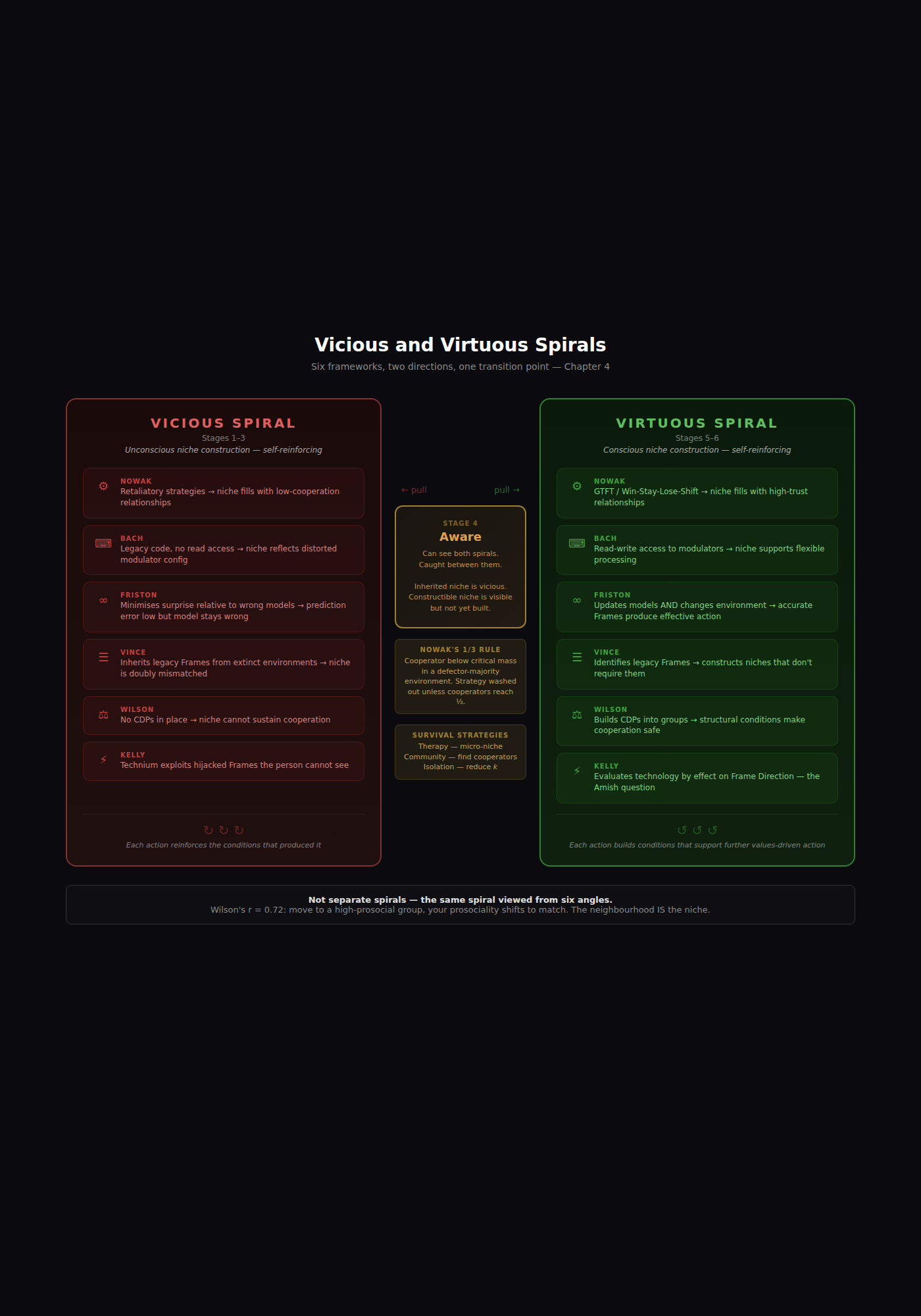
The Vicious Spiral (Stages 1-3). The Muted person constructs niches unconsciously — and the construction follows the logic of every thinker simultaneously:
- They run retaliatory strategies (Nowak) → the niche fills with low-cooperation relationships
- They run legacy code without read access (Bach) → the niche reflects their modulator configuration
- They construct a niche that minimises surprise relative to distorted models (Friston) → the prediction error is minimised but the model remains wrong
- They inherit legacy Frames from environments that no longer exist (Vince) → the niche is doubly mismatched
- Without CDPs (Wilson), the niche cannot sustain cooperation
- The Technium (Kelly) exploits the hijacked Frames the person cannot see
Each framework describes a different mechanism by which the vicious spiral self-reinforces. They are not separate spirals. They are the same spiral viewed from six angles.
The Virtuous Spiral (Stages 5-6). The Intelligent person constructs niches consciously:
- They run GTFT or Win-Stay-Lose-Shift (Nowak) → the niche fills with high-cooperation, high-trust relationships
- They have read-write access to modulators (Bach) → the niche supports flexible processing
- They construct niches that minimise free energy by updating models AND changing the environment (Friston) → accurate Frames produce effective action
- They identify which Frames are legacy and construct niches that don’t require them (Vince)
- They build CDPs into their groups (Wilson) → structural conditions make cooperation safe
- They evaluate technology by its effect on Frame Direction (Kelly) → the Amish question applied personally
The Transition (Stage 4). The Aware person can see both spirals but is caught between them. The inherited niche is still the environment they live in. The constructible niche is visible but not yet built. This maps to Nowak’s 1/3 rule: the person is a cooperator below critical mass in a defector-majority environment. Their cooperative strategy will be washed out by stochastic drift unless they can find or build a group where cooperators reach one-third.
This is why Stage 4 often involves seeking: therapy (a micro-niche with one high-cooperation partner), community (finding a group with enough cooperators), or isolation (reducing k to escape the network density problem). All three are niche construction strategies for surviving below the cooperation threshold.
I did all three. Therapy. New communities. And deliberate reduction of my social network — cutting the connections that were draining the hull, finding the ones that were repairing it. Not because I’d read Wilson. Because the organism was doing what organisms do: constructing the niche it needed to survive.
Wilson’s plasticity finding (r = 0.72) is niche construction in action. When people move to high-prosocial neighbourhoods, their prosociality shifts to match. The neighbourhood IS the niche. The people in it are both constructing and being constructed by it. Leadership, in this architecture, is niche construction at scale.
4.8 Tensions and Limits
Wilson’s group selection remains contested. Inclusive fitness theorists (Dawkins, West) argue group selection is reducible to individual-level selection. If group selection is not a distinct force, the “your development helps your group” argument loses its evolutionary grounding — though the practical observations (CDPs, r = 0.72, plasticity finding) stand regardless of the mechanism. The theoretical claim is held provisionally; the empirical findings are not.
Wilson’s “practical truth” argument is dangerous in the wrong hands. If factually false beliefs can be “practically true” at group level, this can justify any ideology that produces cohesion — including authoritarian, exclusionary, or fundamentalist ones. The architecture must distinguish between practical truth that expands degrees of freedom and practical truth that maintains Muted compliance through fear. Chapter 9 (The Inversion) details exactly how this distinction gets weaponised.
Kelly’s Technium reified as agent. Technology is designed by humans with biases, incentive structures, and Frame distortions. Attributing agency to technology risks obscuring the human choices that shape it. Kelly’s optimism bias is significant — his claim that the attention economy will trend toward “active attention” has no strong evidence since 2010. The mutualism framing is equally consistent with a parasitic reading: domesticated animals are fed and sheltered but also lose freedom.
Vince’s “Homni” is metaphorical, not mechanistic. The slime mold analogy is evocative but does not explain how collective intelligence actually emerges or self-regulates. There is no governance mechanism in the superorganism model. Vince’s Nomad Century prescriptions assume a level of global cooperation that her own mismatch analysis suggests is biologically difficult.
The Amish protocol’s transferability is unproven. The Amish evaluation framework works because of extraordinarily tight communal authority. It does not transfer to individualistic, pluralistic societies without the social infrastructure to enforce communal evaluation. The individual-level equivalent (Stage 5 deliberate curation) requires emotional capacity that most people do not yet have — creating a chicken-and-egg problem.
Kaufman’s biopsychosocial mapping is not yet fully developed in this architecture. The hull/sail dynamic and D-cognition/B-cognition distinction are well-integrated. The detailed needs mapping (which specific needs correspond to which configurations) is an area for future development.
Niche construction requires resources. The ability to reshape your environment — to leave toxic relationships, to change careers, to curate your information diet — is not equally available to everyone. The model must not imply that failure to construct a better niche is an individual failure when structural constraints are the actual barrier. Structures constrain the niche you can build. But within those constraints, the direction of your actions still modifies the environment. This is not “just change your mindset” — the structural barriers are real and must be addressed structurally.
I had privileges that made my niche construction possible — a family that could afford medical school, a country where physical safety was a given, access to books and communities and eventually therapy. Someone running the exact same architecture in structural poverty or active conflict doesn’t have the same niche construction options. The model is honest about the mechanism. It must also be honest about who gets to use it.
Chapter 4 establishes that individual development occurs within conditions — needs systems, relational fields, group dynamics, pedagogical structures, cultural evolution, and technological environments. Wilson’s r = 0.72 demonstrates empirically that configuration is partly a function of conditions, not purely individual achievement. The CDPs provide the structural architecture that makes individual development sustainable. The vicious and virtuous spirals show that niche construction is the mechanism by which individual direction compounds into environmental reality.
With the Mechanism (Chapter 1), Direction (Chapter 2), Pipeline (Chapter 3), and Conditions (Chapter 4) established, one dimension remains: the Configuration itself — the empirically observed state that results from the other four dimensions interacting. That is Chapter 5.