Chapter 2: The Direction — Values, Anti-Values, and the Energy of Frames
This is the story version. For the formal academic version with full theoretical apparatus, read the technical version.
I spent years being helpful. Not because I was naturally generous — because I had no other currency.
After the bullying started, I discovered that the one reliable way to earn social access was to be useful. Help with homework. Be the one who shows up when someone’s in trouble. Carry the load nobody asked you to carry. I didn’t have the instinctive social fluency that would have let me connect naturally, so I built a workaround: make yourself indispensable, and people will keep you around.
It worked. And it nearly destroyed me.
Because here’s what I didn’t understand until decades later: the helping looked like a value — generosity, service, compassion — but the energy driving it pointed in the wrong direction. I wasn’t helping toward something. I was helping away from something. Away from rejection. Away from the kid who didn’t count. Away from the terror of being alone again. The helping was real. The people I helped genuinely benefited. But the engine underneath was running on fear, not purpose.
This chapter is about that distinction — the axis that determines whether the mechanism from Chapter 1 produces creation or destruction. It’s one of the two load-bearing walls of the entire architecture.
2.1 What Values Actually Are
In common usage, “values” means things like honesty, integrity, loyalty, compassion. They’re taught in schools, printed on corporate walls, and tested in personality assessments. Frameworks like Schwartz’s Theory of Basic Values and Rokeach’s Value Survey all operate at this level.
In this model, those are not values. They are Frames.
Values — true values — are core personhood. They are the person’s purpose, being, and existence. They sit at the deepest level of identity, before thought, before language, before any framework can reach them.
| Common Usage | This Model |
|---|---|
| “I value honesty” | “Honesty is one of my Frames” |
| “My core values are…” | “My core Frames are…” |
| Values drive behaviour | Values are core personhood; Frames filter perception; behaviour follows from the pipeline |
This distinction has practical consequences. When someone says “I value honesty” and then lies to protect a relationship, we call it hypocrisy. But in this model, it makes perfect sense: their Frame (honesty) was overridden by a deeper Frame (relationship preservation), which itself serves a Value (connection, belonging, love). The “inconsistency” is a complex negotiation between Frames — and understanding that negotiation is far more useful than labelling someone a hypocrite.
2.2 Frames: The Lenses We Build
Frames are the specific, definable concepts through which we view the world — what personality systems typically call “values.” Much like a picture frame, a Frame decides which elements of reality we perceive and give weight to.
I’ve watched Frames form in real time — in the people I’ve studied, in the students I’ve trained, in myself. They come from everywhere:
- Experience — what we’ve lived through teaches us what matters
- Culture — the society we’re embedded in provides default Frames
- Teaching — explicit instruction about what is right, good, important
- Trauma — unresolved wounding creates Frames aimed at preventing recurrence
- Visioning — the unconscious sensing of purpose that precedes language (see Chapter 3)
Frames are not good or bad. They are lenses. The question is whether a given Frame is serving you — moving you toward what you actually want — or controlling you — running on autopilot from an old wound.
2.3 Adopted vs Hijacked: The Directional Test
This is the insight that changed everything for me. Not just as a framework — as a way of understanding what had been happening inside me for thirty years.
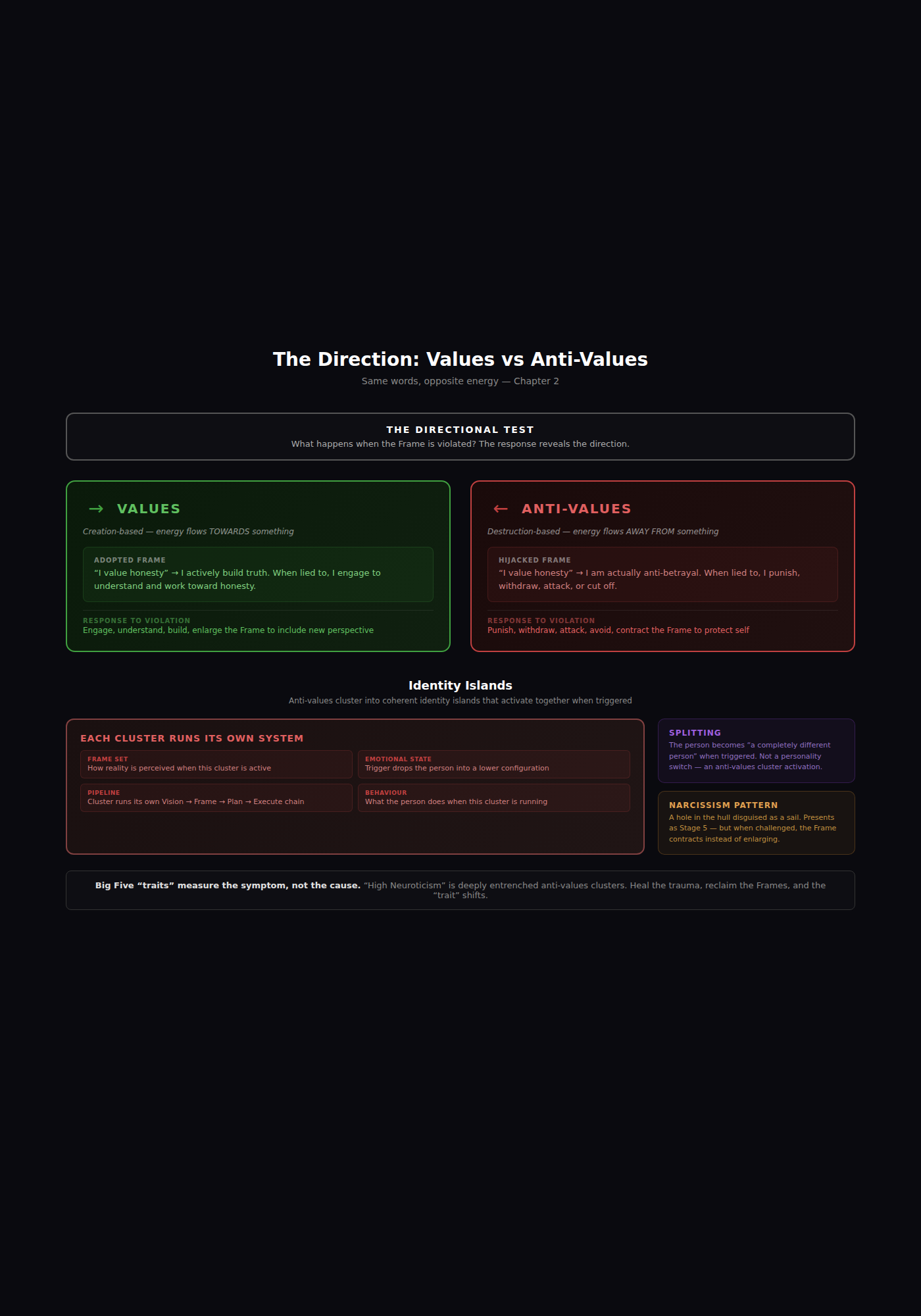
Adopted Frames are creation-based. They point towards something:
“I value honesty” → I actively build truth in my relationships. When someone lies to me, I engage with them to understand why and work toward honesty. The energy flows towards creating something.
Hijacked Frames are destruction-based. They point away from something. They emerge from unresolved trauma:
“I value honesty” → I am actually anti-betrayal, anti-lies, anti-hiding. When someone lies to me, I punish, withdraw, attack, or cut them off. The energy flows away from the thing I fear. I am not building honesty. I am destroying deception.
Same topic. Same words. Completely different energy direction.
When I finally applied this test to myself — honestly, unflinchingly — I discovered that most of what I called my “values” were anti-values. My “generosity” was anti-rejection. My “tolerance” was anti-conflict. My “self-sufficiency” was anti-dependence. Every single one was a Frame that had been hijacked by a wound and pointed in the wrong direction while wearing the costume of a virtue.
The test is simple: what happens when the Frame is violated?
| Response to Violation | Direction | Classification |
|---|---|---|
| Engage, understand, build | Towards | Values-driven |
| Punish, withdraw, attack, avoid | Away-from | Anti-values-driven |
A person who “values family” and responds to a family conflict by engaging, listening, and working to understand — that is values-driven. A person who “values family” and responds by guilt-tripping, withdrawing love, or demanding compliance — that is anti-values-driven. They are not protecting the family. They are protecting themselves from the fear of losing it.
I watched my own saviour pattern through this lens and saw it clearly for the first time: every act of “helping” that was driven by the fear of being rejected was anti-values. Not because the helping was wrong — the people I helped genuinely needed help — but because the engine underneath was running on fear. And fear-based helping has a cost: it creates dependency, breeds resentment, and eventually collapses when the helper runs out of fuel. Which is exactly what kept happening.
2.4 The Mathematics of Direction: Nowak’s Cooperation Rules
I’m not asking you to take my word for it that the directional distinction matters. The mathematics proves it.
In the winter of 1914, something happened on the Western Front that the generals on both sides found deeply alarming. Along a 475-mile line of trenches stretching from the English Channel to Switzerland, soldiers who were supposed to be killing each other started cooperating instead.
It began with meals. Both sides needed to eat, and eating meant leaving the trench, which meant exposure. Without any communication, without any agreement, units on both sides began to hold fire during mealtimes. Not a formal truce — just a pattern. You don’t shoot during breakfast. We don’t shoot during breakfast. If you shoot during our breakfast, we shoot during yours tomorrow. If you hold fire, we hold fire.
The pattern spread. Artillery units began firing at the same coordinates at the same time every day — predictable, avoidable, technically fulfilling the order to fire while ensuring no one actually died. One British officer arriving at his trench was astonished to find that his men could walk freely during certain hours. When he ordered an attack, the German side retaliated fiercely — and then, once the new officer was rotated out, the old pattern resumed. The soldiers had discovered, without game theory, without mathematics, without any formal framework, what Martin Nowak would later prove: cooperation is a mathematical phenomenon, and it obeys precise rules.
Robert Axelrod documented this in The Evolution of Cooperation (1984). The strategy the soldiers were running was Tit-for-Tat — cooperate first, then mirror what the other side does. It was exactly the strategy that won Axelrod’s famous computer tournament, where he invited game theorists worldwide to submit strategies for the repeated Prisoner’s Dilemma. TFT beat every sophisticated strategy submitted: simple, forgiving, retaliatory, clear.
But Nowak’s later work showed something deeper. In noisy environments — where mistakes happen, signals are ambiguous, and misperceptions occur (which describes every real relationship and certainly every relationship I’ve ever had) — Tit-for-Tat collapses. One misunderstanding triggers retaliation, which triggers counter-retaliation, which spirals into mutual defection. The trenches’ live-and-let-live system was fragile for exactly this reason: a single new officer ordering an attack could destroy months of built-up cooperation in an afternoon.
Nowak discovered two strategies that outperform TFT in noisy environments:
- Generous Tit-for-Tat (GTFT): Cooperate even after the opponent defects, with forgiveness probability p = 1 - (c/b). The forgiveness rate is mathematically calibrated to the cost-benefit structure.
- Win-Stay, Lose-Shift (WSLS): Repeat your last move if the payoff was high; switch if low. Outperforms TFT because it self-corrects errors without tracking the opponent’s history.
The directional test from Section 2.3 maps precisely onto this mathematics. The anti-values response to violation — punish, withdraw, attack — IS the punishment strategy. And Nowak proved it loses. Costly punishment increases cooperation frequency but does NOT increase average group payoff: the costs of punishment cancel the cooperation gains. The individuals with the highest total payoffs are those who never punish. Punishment triggers “downward spirals of retaliation.”
The values response — engage, understand, build — IS the reward strategy. GTFT. Mathematically superior.
When I read Nowak, I felt the hair on my arms stand up. The directional test I’d developed from watching people for twenty years — engage or punish, toward or away — had a mathematical proof. The pattern I’d seen in every relationship, every workplace, every family dynamic was not just a useful observation. It was a game-theoretic finding. The soldiers in those trenches had discovered the same thing through lived experience that Nowak later proved with equations.
Nowak’s five rules formalise cooperation into five mechanisms, each with a precise mathematical threshold. A cooperator pays cost c so another receives benefit b. Cooperation is favoured only when the benefit-to-cost ratio exceeds a mechanism-specific critical value:
| # | Mechanism | Rule (cooperation favoured when) | Key Variable |
|---|---|---|---|
| 1 | Kin Selection | b/c > 1/r | r = coefficient of relatedness |
| 2 | Direct Reciprocity | b/c > 1/w | w = probability of another interaction |
| 3 | Indirect Reciprocity | b/c > 1/q | q = probability of knowing reputation |
| 4 | Network Reciprocity | b/c > k | k = average number of neighbours |
| 5 | Group Selection | b/c > 1 + n/m | n = group size, m = number of groups |
GTFT is not unconditional forgiveness — it is forgiveness mathematically tuned to what the situation can bear. But it requires emotional capacity the Muted person does not yet have: you must accurately assess costs and benefits to set the forgiveness rate correctly. The mathematics of optimal cooperation demand emotional development. The soldiers in the trenches could run TFT because the environment was simple — two sides, repeated interactions, clear payoffs. Real relationships are noisier than a trench line. They require GTFT. And GTFT requires the emotional capacity to absorb a defection without retaliating — to hold the anger, assess the situation, and choose engagement over punishment. That’s a Stage 5 capability being demanded by the mathematics.
Important label: The application of Nowak’s mathematics to intrapsychic dynamics (anti-values as “internal defection”) is productive analogy, not rigorous mathematics. Nowak’s equations describe interactions between agents. The mapping to Frame direction within a single person is metaphorical — illuminating, but not mathematically rigorous. What IS mathematically rigorous is the interpersonal application: the person running anti-values Frames is running the punishment strategy in their relationships, and Nowak proves that strategy loses.
2.5 The Mechanics of Hijacking: Defence Mechanisms
If anti-values are the direction, defence mechanisms are the machinery that gets the Frames pointed there. Anna Freud catalogued them. I learned them in medical school. But I didn’t understand what they were until I caught them operating in myself.
| Defence Mechanism | How It Hijacks | Configuration Where Dominant |
|---|---|---|
| Repression | Pushes the threatening emotion below awareness; the Frame operates without conscious access to what drives it | Muted |
| Rationalisation | Constructs a logical justification for the anti-values Frame, disguising destruction as reason (“I’m not angry, I’m just being realistic”) | Muted |
| Intellectualisation | Strips emotion from the Frame entirely; the person can describe the pattern but can’t feel it | Muted |
| Projection | Attributes the rejected Frame to others (“they’re the dishonest ones, not me”) | Inhibited |
| Displacement | Redirects the Frame’s energy to a safer target (anger at boss → kicks the dog) | Inhibited |
| Reaction Formation | Inverts the Frame — performs the opposite of what the trauma drives (“I’m the most generous person” masking deep selfishness born from scarcity) | Muted / Inhibited |
| Regression | Reverts to an earlier, simpler Frame when overwhelmed | Inhibited / Distracted |
Rationalisation was the one that ran me the longest. I could construct a perfectly logical explanation for every anti-values behaviour I exhibited. “I’m not being judgemental, I’m being discerning.” “I’m not withdrawing, I’m setting a boundary.” “I’m not helping to avoid rejection, I’m helping because I care.” Each one was airtight from the inside. Each one was a hijacked Frame wearing the mask of Adult reasoning.
These mechanisms are not pathology. They are the operating system of the anti-values engine. They are how the psyche protects itself from overwhelming experience. The problem is not that they exist — it’s that they run unconsciously and convert creation-based Frames into destruction-based ones without the person’s awareness or consent.
Shadow work (Jung) is the process of making these mechanisms visible. The shadow IS the anti-values content — the repository of every Frame you’ve rejected, every emotion you’ve repressed, every part of yourself you’ve declared unacceptable. Shadow integration doesn’t mean destroying the defence mechanisms. It means seeing them, understanding what they’re protecting, and gradually reclaiming the Frames they’ve hijacked.
2.6 Identity Clusters and Splitting
Anti-values don’t operate as isolated Frames. They cluster into identity islands — coherent sets of hijacked Frames that activate together when triggered.
I’ve watched this happen in real time, in others and in myself. The person who appears to become “a completely different person” when triggered. The colleague who is warm and competent until they’re challenged, at which point something switches and they become cold, cutting, unreachable. In clinical terms, this is splitting. In this model, splitting is the activation of an anti-values cluster.
Each cluster is an identity island — a coherent set of trauma-hijacked Frames, complete with its own:
- Frame set (how reality is perceived when this cluster is active)
- Emotional state (the trigger drops the person into a lower configuration)
- Pipeline (the cluster runs its own Vision → Frame → Plan → Execute chain)
- Behavioural repertoire (what the person does when this cluster is running)
I had my own clusters. The sharp one that emerged when I felt dismissed — a complete identity island with its own Frame set (“they don’t respect me”), emotional state (cold anger), and behavioural repertoire (precise, cutting words designed to wound). It activated as a coherent package, ran its program, and then receded, leaving me wondering who had just spoken with my mouth.
This is what was happening to those soldiers in the trenches when a new officer arrived and ordered an attack. The cooperative identity island — the live-and-let-live system — was deactivated by the authority Frame (“obey orders”), which triggered the combat identity island. Same soldiers. Different cluster running. The officer’s command was a trigger that switched which identity island was active — not through persuasion but through Frame activation.
What personality trait psychology measures as stable “traits” is actually the depth and entrenchment of anti-values expression. What the Big Five calls “high Neuroticism” is a person with deeply entrenched anti-values clusters that activate frequently. The “stability” of the trait reflects the stability of unhealed trauma patterns, not the fixedness of personality. Heal the trauma, reclaim the Frames, and the “trait” shifts.
The Narcissism Pattern: A Hole Disguised as a Sail. Kaufman identifies narcissism as defensive self-esteem — in sailboat terms, a hole in the hull disguised as a sail. In this model: narcissism is an anti-values cluster that presents as high functioning. The person appears to have strong Frames, clear Vision, decisive Execution — but the energy direction is away-from. The confidence is built on the maintenance of superiority, not on integrated security. The directional test exposes it: when challenged, a genuinely Intelligent person’s Frames enlarge to include the new perspective. A narcissist’s Frames contract — they punish, dismiss, or discard the challenger.
2.7 Boundaries, Expectations, and Rules
The directional test tells you whether a Frame is hijacked. This section tells you how the hijacking expresses itself.
People conflate three things that are structurally different:
Boundaries are what I will do if you cross into my space. Self-referential. Locus of control: internal. “If you continue to speak to me this way, I will end this conversation.”
Expectations are what I want you to do. Locus of control: external. “I need you to stop speaking to me that way.”
Rules are what happens to you if you follow or don’t follow. Locus of control: imposed. “If you speak to me that way again, there will be consequences.”
| Category | Structure | TA Ego State | Locus of Control | Arousal Pattern |
|---|---|---|---|---|
| Boundary | “I will [my action] if [condition]” | Adult | Self | Processes and resolves |
| Expectation | “I want you to [your action]” | Adapted Child or Nurturing Parent | Other | Sustains until met |
| Rule | “If you [action], [consequence to you]” | Controlling Parent | Imposed | Sustains and escalates |
A boundary is values-driven by structure — it describes my action, the arousal processes and resolves, and the other person’s autonomy is intact. A rule is anti-values by structure — it describes a consequence I impose on you, the arousal sustains because I am now monitoring your compliance.
I learned this distinction the hard way. For years, I thought I had “strong boundaries.” What I actually had was a sophisticated set of rules I imposed on others while using boundary language to disguise them. “I won’t tolerate dishonesty” sounds like a boundary. But if your version of “not tolerating dishonesty” is monitoring the other person’s behaviour for signs of deception and punishing when you find them — that’s a rule running on anti-values fuel. The giveaway is the arousal pattern: genuine boundaries process and resolve. Rules require ongoing vigilance. If your “boundary” requires you to monitor the other person’s behaviour, it’s a rule.
The same content expressed three ways:
| Content | As Boundary | As Expectation | As Rule |
|---|---|---|---|
| Punctuality | “If meetings start late, I’ll stop attending” | “I need you to be on time” | “Lateness will be noted in your review” |
| Honesty | “I won’t continue relationships where I’m lied to” | “I need you to tell me the truth” | “If I catch you lying, consequences” |
| Respect | “When I feel disrespected, I step away” | “I need you to speak respectfully” | “Disrespectful behaviour won’t be tolerated” |
A note on institutional sanctions: Not all imposed consequences are anti-values rules. A group that has collectively agreed on fair processes, graduated sanctions, and conflict resolution mechanisms (Wilson’s Core Design Principles — see Chapter 4) is operating from collective Adult. The consequences are authored together, applied proportionally, and serve correction rather than punishment. This is the distinction between the soldiers’ organic cooperation in the trenches and the officers’ hierarchical commands — the first emerged from mutual benefit, the second was imposed from above.
Zone, Deemed Space, and Judgement
The boundary/expectation/rule distinction operates on a second axis: what space is actually being defended?
Zone is a person’s real space — basic human rights, bodily autonomy, physical safety, psychological integrity. Non-negotiable. Max-Neef’s nine fundamental human needs (subsistence, protection, affection, understanding, participation, leisure, creation, identity, freedom) are the content of the Zone.
Deemed space is what people believe is their space but is actually a preference projected as entitlement. “I don’t want to see people dressing like that around me.” The discomfort is real. The claim that others must modify their behaviour is not a boundary — it is an expectation disguised as a Zone right. Humans defend psychological comfort zones with the same instinctive intensity as physical territory — which is why deemed space feels like Zone.
Judgement is othering disguised as boundary. “All [group] who [trait] are [conclusion].” In TA terms: Parent contamination of Adult.
| Level | What Is Defended | Negotiable? | Source |
|---|---|---|---|
| Zone | Basic rights, bodily autonomy | No | Biological/universal |
| Deemed Space | Comfort preferences as entitlement | Yes, but presented as no | Psychological territory |
| Judgement | Identity threatened by others’ existence | Not a boundary at all | Othering |
How Boundaries Get Contracted: Steiner’s Rule 4
The ability to hold genuine boundaries depends on knowing where your Zone is. For many people, the Zone was contracted in childhood through Steiner’s Stroke Economy — specifically Rule 4: Don’t reject strokes when you don’t want them. The anti-boundary injunction. It teaches the child: your Zone is not yours.
The child who cannot reject unwanted contact grows into the adult who either:
- Has no boundaries (enmeshed) — cannot tell where their Zone ends and another person’s expectations begin
- Builds rigid walls and calls them boundaries (rigid) — rules so thick no one can enter, but the Zone itself remains unrecovered
Neither is an Adult boundary. Both are trauma responses. Recovery requires recognising the Zone exists (Aware stage), then recovering its dimensions through enlargement — not installing new rules but integrating the old invasion into a larger Frame that includes “my Zone is mine, AND connection is possible.”
I was the rigid type. I built walls so high they looked like fortresses and called them boundaries. Inside the fortress, the Zone was still contracted — still the size a child’s world had made it. The walls didn’t protect the Zone. They hid it.
2.8 How Configuration Determines Direction
This is the bridge between Chapter 1 and Chapter 2:
| Configuration | Default Frame Direction | Mechanism |
|---|---|---|
| Distracted | Neither — survival mode | No stable Frames to direct |
| Inhibited | Anti-values | Trauma triggers hijack Frames before conscious processing |
| Muted | Anti-values (disguised) | Frames maintained by willpower, energy is avoidance-based |
| Aware | Both visible | Can see the hijacking but can’t yet choose |
| Intelligent | Values (predominantly) | Conscious Frame management, creation-based default |
| Transcendent | Values (integrated) | Frames as tools, no attachment, creation is natural |
The Aware stage is the turning point. Below it, you cannot see the difference between your values and your anti-values because the emotional state keeps the mechanism unconscious. Above it, you can choose.
This is why trauma healing and emotional development are prerequisites for genuine values-based living. You cannot choose creation while your nervous system is locked in survival. The instruction to “just choose positive values” is useless to someone in a Muted configuration — which is exactly what most corporate values exercises and motivational seminars try to do. They put words on the wall without touching the engine underneath.
I spent years at Muted. Running elaborate anti-values programs — the saviour, the competent generalist, the non-judgmental one — all of which looked like values from the outside and felt like values from the inside. The directional test was the first tool that cut through the performance. Not “what do you believe?” but “what happens when the belief is violated?” That question changed everything.
2.9 Tensions and Limits
The values/anti-values taxonomy is the model’s own framework. It has not been independently validated beyond the GREAT instrument. The directional test is clinically useful but not experimentally validated in controlled settings.
The punishment paradox is unresolved. Nowak says winners don’t punish. Wilson’s Core Design Principles (Chapter 4) include graduated sanctions. The proposed resolution — retaliatory punishment (destructive) vs proportional correction (constructive) — is proposed but not formally proven. This tension is flagged, not resolved.
Nowak’s “cooperation as third fundamental principle of evolution” is Nowak’s position, not consensus. Mainstream evolutionary biology generally sees cooperation as an outcome of selection, not a co-equal principle. The mathematical findings (five rules, thresholds, GTFT) stand regardless.
The Nowak-to-intrapsychic mapping is analogy. As stated in 2.4, applying cooperation mathematics to internal Frame direction is productive metaphor, not rigorous mathematics. The interpersonal application IS mathematically grounded. The intrapsychic application illuminates but does not prove.
The Big Five reframing is a strong claim. Asserting that stable traits are “symptoms” of entrenched anti-values clusters contradicts the mainstream consensus. The longitudinal evidence for trait stability is robust. The model’s position — that traits measure the stability of unhealed patterns — is consistent with evidence that traits do change over the lifespan, but the claim that trauma healing would produce large-scale trait shifts has not been empirically tested. This is an honest limit.
Chapter 2 establishes the directional axis. Every Frame points somewhere — toward creation or away from threat. The directional test is binary: engage or punish. Nowak’s mathematics confirm this is not just a therapeutic observation but a game-theoretic finding. The mechanics of hijacking, the structure of anti-values clusters, and the practical diagnostics of boundaries, expectations, and rules provide the tools for identifying direction in real time.
But direction alone is not action. The mechanism (Chapter 1) processes input; the direction (Chapter 2) determines which way the energy flows. The pipeline that converts that energy into decisions and behaviour is Chapter 3.